
40-Foot Shipping Container
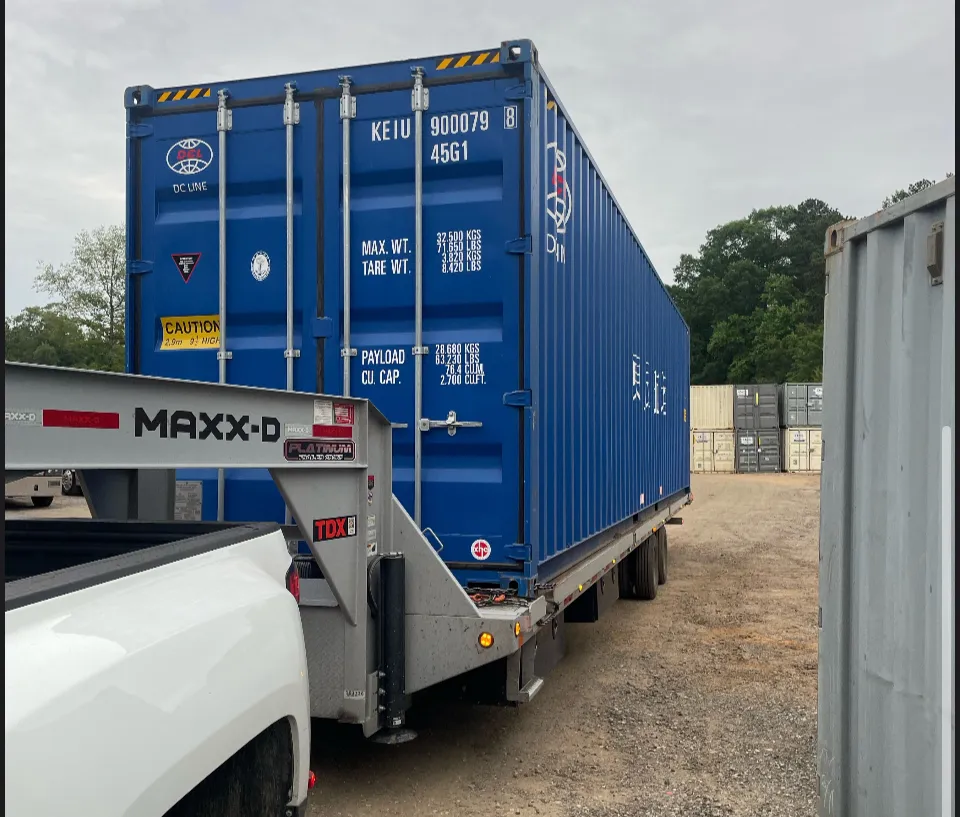
Maximum storage. The industry standard for serious projects.
Avg. starting price, seven home metros
$2,320
Average starting price, not a quote; yours may be more or less. Your ZIP code is a big factor in the delivered price, so for the most accurate number, talk directly to Doug. (October 2026)
Rather write it all down? Build my full quote
See the delivered price in your city
Searching for a conex box instead? Same steel, different name: conex boxes for sale
Not ready to pay it all at once? Rent to own from $99 down.
$99 applies to standard containers delivered within 150 miles of the depot your container ships from; 20% down beyond that. Administered by My Container Rental, an independent third party, and subject to their approval. How rent to own works
| Measurement | Length | Width | Height |
|---|---|---|---|
| ExternalWhat your pad has to take | 40' | 8' | 8'6" |
| InternalThe space you get to fill | 39'5" | 7'8" | 7'10" |
| Door openingWhat has to fit through it | - | 7'8" | 7'5" |
Payload and tare are typical figures from carrier spec sheets and vary by box; the CSC plate on the door is the authority for yours.
Compare all three sizes →See It In 3D
This is a 40ft standard, modeled to spec, and you can handle it on screen. It opens half pulled apart, so the crossmembers, the plywood subfloor and the corner castings are the first thing you see; push it back together, spin it, swing the cargo doors, look at how the thing is built before you read a single number about it. Every measurement behind the model is in the specification table below. On a phone you get the exploded view as a still image instead.

For the interactive version, view on desktop
What it is
The box itself, in numbers first and then in condition: every measurement for all three sizes, and what Wind and Water Tight actually looks like when it is on your pad.
Specifications, and how the three sizes compare
All three sizes are Wind & Water Tight (used): no holes, doors that seal, and storage-ready, with honest cosmetic wear from prior service.
| 20ft | 40ft | 40ft High Cube | |
|---|---|---|---|
| External | 20' L × 8' W × 8'6" H | 40' L × 8' W × 8'6" H | 40' L × 8' W × 9'6" H |
| Internal | 19'4" L × 7'8" W × 7'10" H | 39'5" L × 7'8" W × 7'10" H | 39'5" L × 7'8" W × 8'10" H |
| Door opening | 7'8" W × 7'5" H | 7'8" W × 7'5" H | 7'8" W × 8'5" H |
| Cubic capacity | 1,172 cu ft | 2,390 cu ft | 2,694 cu ft |
| Payload (typical) | 62,020 to 62,280 lbs | 59,000 to 63,490 lbs | 58,600 to 63,100 lbs |
| Tare weight (typical) | 4,920 to 5,180 lbs | 8,160 to 8,270 lbs | 8,550 to 8,600 lbs |
| Best for | Half the length of a 40ft, so it fits tighter spaces and costs less to deliver. | Twice the storage of a 20ft, but it needs more clearance for delivery and placement. | Same footprint as the standard 40ft, but a foot taller, with the most headroom and cubic capacity we offer. |
Payload and tare are typical figures from carrier spec sheets and vary by box; the CSC plate on the door is the authority for yours.
Full ISO 668 dimensions for every size are in our Container Reference.
Weighing it against the shorter box? Is a 40ft worth it over a 20ft?
What Wind and Water Tight actually means
Wind & Water Tight (used): no holes, doors that seal, and storage-ready, with honest cosmetic wear from prior service.
It spent years at sea. It looks like it. Expect surface rust, patched paint, dents in the corrugation and a previous owner's markings, over weathering (Cor-Ten) steel built to last decades. What you should not expect is daylight through the roof, a floor that gives, or door seals that have gone.
It is the one grade we stock, in all three sizes, sealed against rain, wind, snow and pests, and sold as-is for storage and on-site use. There is no upsell ladder here and no surprise downgrade at delivery: what you are quoted is what arrives. The full condition guide
Lifetime Leak Warranty
Find a leak and we send you an industry-approved fiberglass patch kit, with instructions, that you apply yourself. Water on the ceiling is often condensation, not a leak.
That is the entire remedy, and we state it here rather than in fine print, because the remedy is where every warranty argument in this business ends up. Read the terms
One honest grade, named before you pay
Bait-and-switch grading is one of the most common tactics in this market: a seller quotes a nicer grade, then delivers something worse. We stock one grade, we name it on every page, and it is the grade on the invoice.
How you get it
The price, what moves it and rent to own are in the buy box above, where a buyer who scrolled here for a number should not have to hunt for one. This is the rest of getting it: when it arrives, where it lands, and the only time this page asks you for anything.
When it arrives, and where it lands
The date
Almost all deliveries take about two weeks, and we will give you an honest window before you commit.
Depot inventory is stacked and sequenced rather than staged for a quick pull, and drivers book out several weeks ahead, so exact timing depends on current availability and where you are. Scheduling depends on independent drivers and can shift; that is true of container delivery generally, and Steel Box Direct does not control it.
The spot
A tilt-bed sets the container along the line the truck was traveling, so placement is directional: if you want the doors facing the house, that has to be planned before the truck backs in. Mark the exact spot with stakes, paint or cones at the four corners, and have somebody on site who can point at it and make a decision.
Send photos of the approach with your quote request and we can tell you before delivery day whether a tilt-bed can make it, or whether a crane set is the better call. Almost everything that goes wrong on delivery day is access, not the box. An hour of looking at your driveway now is the cheapest hour in the whole transaction.
A loaded container delivery rig is roughly a sixty-five foot truck combination. For a tilt-bed delivery it needs at least 100 feet of straight approach, 12 feet of width clearance at the narrowest point of the route, and 14 feet of overhead clearance for branches and wires. The ground along the route and at the drop point has to support a 30,000 lb truck. When a site cannot provide that, a crane-set delivery places the container instead.
Get Your 40ft Price
Skip the forms. Talk to Doug.
We answer calls 9am to 9pm ET, every day.
Want it all in writing?
Build my full quoteEvery detail, one form, quote back within 4 business hours.
Where and who it comes from
No walk-up yard: a network of regional depots, an operating container company, and Doug. This is the part you can go and check yourself before you pay anybody in this business a dollar.
Is this a real company?
Most people buying a used container have never bought one before, and what they are actually afraid of is paying a stranger and never seeing a box. That is a fair thing to be afraid of in this business. So here is what you can check about us before you send anyone any money.
A traceable business
Steel Box Direct is the authorized independent agent of Freedom Conex LLC, an operating company that sells containers. That is a company you can look up, not a phone number and a stock photo of a yard.
A phone a person answers
Doug Froh handles every quote personally, start to finish. We answer calls 9am to 9pm Eastern, every day, and most quote requests come back within 4 business hours.
A real delivery footprint
We deliver within roughly 250 miles of Cincinnati, across Ohio, Indiana, Kentucky and western West Virginia, from real regional depots. Our home metros include Dayton, Lexington and Huntington, WV. Beyond the home region we ship from depot hubs nationwide.
A delivered total, not a sticker price
We quote all-in on purpose: the container, delivery to your ZIP, and placement on flat ground, in one number, so there is no freight line arriving after you have agreed a price.
Red flags, whoever you end up buying from
This applies to any seller, anywhere, including us. If a seller does these things, slow down.
- Pressure to wire money, send Zelle or pay in cryptocurrency before you have verified who you are dealing with
- An invoice payable to a person's name rather than to a business
- Stock yard photos instead of photos of the specific unit, and no CSC plate to check
- A condition grade that is described on the phone and never written down
- Manufactured urgency: today only, another buyer is waiting
Questions, answered on the page
Everything below is already argued at length somewhere above, or on a guide this page links to. It is repeated here in the shortest honest form, in the order buyers actually ask it, so that nobody has to read the whole page to get an answer.
- Q1Is delivery included in the price?
-
Within 250 miles of Cincinnati, yes. We quote all-in on purpose: the container, delivery to your ZIP, and placement on flat ground, in one number, rather than a container price with a freight line arriving later. The figure at the top of this page is a delivered average across the home metros, not a bare unit price with delivery still to come. Past that home region we deliver from regional depot hubs, and the delivery cost depends on the distance from the depot your container ships from, so that one has to be quoted for your address.
- Q2How long does delivery actually take?
-
Almost all deliveries take about two weeks, and we will give you an honest window before you commit. Depot inventory is stacked and sequenced rather than staged for a quick pull, and drivers book out several weeks ahead, so exact timing depends on current availability and where you are. Scheduling depends on independent drivers and can shift; that is true of container delivery generally, and Steel Box Direct does not control it.
- Q3Will the driver put it exactly where I want it?
-
Where it lands is decided before delivery is scheduled, not on delivery day. A tilt-bed does not lower the container down: it raises the front of the bed and the box slides off the back while the truck creeps forward, so the container lands in a straight line along the truck's path. Placement is directional, and if you want the doors facing the house, that has to be planned before the truck backs in.
So send photos of the route and the placement spot with your quote request, mark the exact spot with stakes, paint or cones at the four corners, and have somebody on site who can point at it and make a decision. Where a site cannot give the truck what it needs, a crane-set delivery places the container instead: that exists precisely for sharp turns, fencelines and soft ground.
It is worth knowing what happens if the site will not take it, because it costs money. Under our terms, if delivery cannot be made due to space limitations or an unsuitable environment, for example wet ground, snow, mud, no clear path, graded hills or low bridges, it is the customer's responsibility to cover the transport fee, the return delivery fee, and any third-party costs such as wrecker or tow charges. If there is not adequate space, we confer with you to either call the attempt a failed delivery or agree an alternate suitable location. An hour spent looking at your access now is the cheapest hour in the whole transaction.
- Q4What does Wind and Water Tight mean, and what wear should I expect?
-
Wind & Water Tight (used): no holes, doors that seal, and storage-ready, with honest cosmetic wear from prior service. It is the one grade we stock, in all three sizes, sealed against rain, wind, snow and pests, and sold as-is for storage and on-site use. It spent years at sea and it looks like it. Expect surface rust, patched paint, dents in the corrugation and a previous owner's markings, over weathering (Cor-Ten) steel built to last decades. What you should not expect is daylight through the roof, a floor that gives, or door seals that have gone.
- Q5What happens if it leaks?
-
There is a limited Lifetime Leak Warranty, and the remedy is the part worth knowing before you buy rather than after. If you discover a leak, we send you an industry-approved equipment patch along with installation instructions, and the patch is installed by you.
It is a durable fiberglass-reinforced polyester fabric that bonds to the metal surface, flexible and easy to apply, and it becomes solid when fully cured: roughly five to ten minutes under a UV lamp or direct sunlight, one to two hours in other conditions. Once cured it can be drilled, sanded or painted. That is the entire remedy, and we state it here rather than in fine print, because the remedy is where every warranty argument in this business ends up. Read the terms
- Q6What do I need to set it on?
-
Level ground that drains, and no slab to pour. A container carries its load at its four corner castings, and when one corner sits low the frame twists slightly; that twist shows up at the door end, because the door opening is the one side of the box with no wall across it, and the result is doors that bind or will not latch fully. Level side to side matters most for door operation, and keeping the container up out of standing water lets the underside dry between rains. Gravel is the most reliable surface because it drains and spreads load. Packed dirt is dependable when dry and much less so when wet. Grass is the one that fools people: turf is a thin mat over topsoil, and topsoil holds water, so a lawn that felt solid underfoot in the morning can rut badly under loaded tires by the afternoon. If you want the container set on blocking, say so in your quote request: blocking changes how the box comes off the truck, and it has to be planned before the driver is on your property rather than decided in your driveway.
- Q7Will a truck fit down my driveway?
-
A loaded container delivery rig is roughly a sixty-five foot truck combination. For a tilt-bed delivery it needs at least 100 feet of straight approach, 12 feet of width clearance at the narrowest point of the route, and 14 feet of overhead clearance for branches and wires. The ground along the route and at the drop point has to support a 30,000 lb truck. When a site cannot provide that, a crane-set delivery places the container instead.
Measure the narrowest point of your route rather than the average: gate posts, a mailbox, a parked truck, the corner of the garage. And look up at the drop spot as well as at the lane, because when the bed tilts the raised end reaches higher than the truck stood driving in. See the clearance figures in section 03.